


Our Matcha
What is ceremonial grade matcha?
Ceremonial grade matcha is the highest grade of matcha powder. It is made from the youngest tea leaves of the first spring harvest, grown in the shade and slowly ground on stone mills. The result is a fine, bright green powder that is meant to be whisked with water and drunk on its own, without milk or sugar.
The tricky part is that "ceremonial grade" is not a protected term. There is no official inspector who checks the claim, so anyone can print it on a bag. If you want to know what you are really buying, you have to look at where the matcha comes from, when it was picked and how it was ground. Our 30g pouch answers those three questions right on the label.
What does single-origin Uji matcha mean?
Single-origin means that every gram in your pouch comes from one estate in one valley, harvested in a single window. Most matcha is a blend of leaves from different regions or even different years, mixed to keep the taste consistent and the price low. Ours is not.
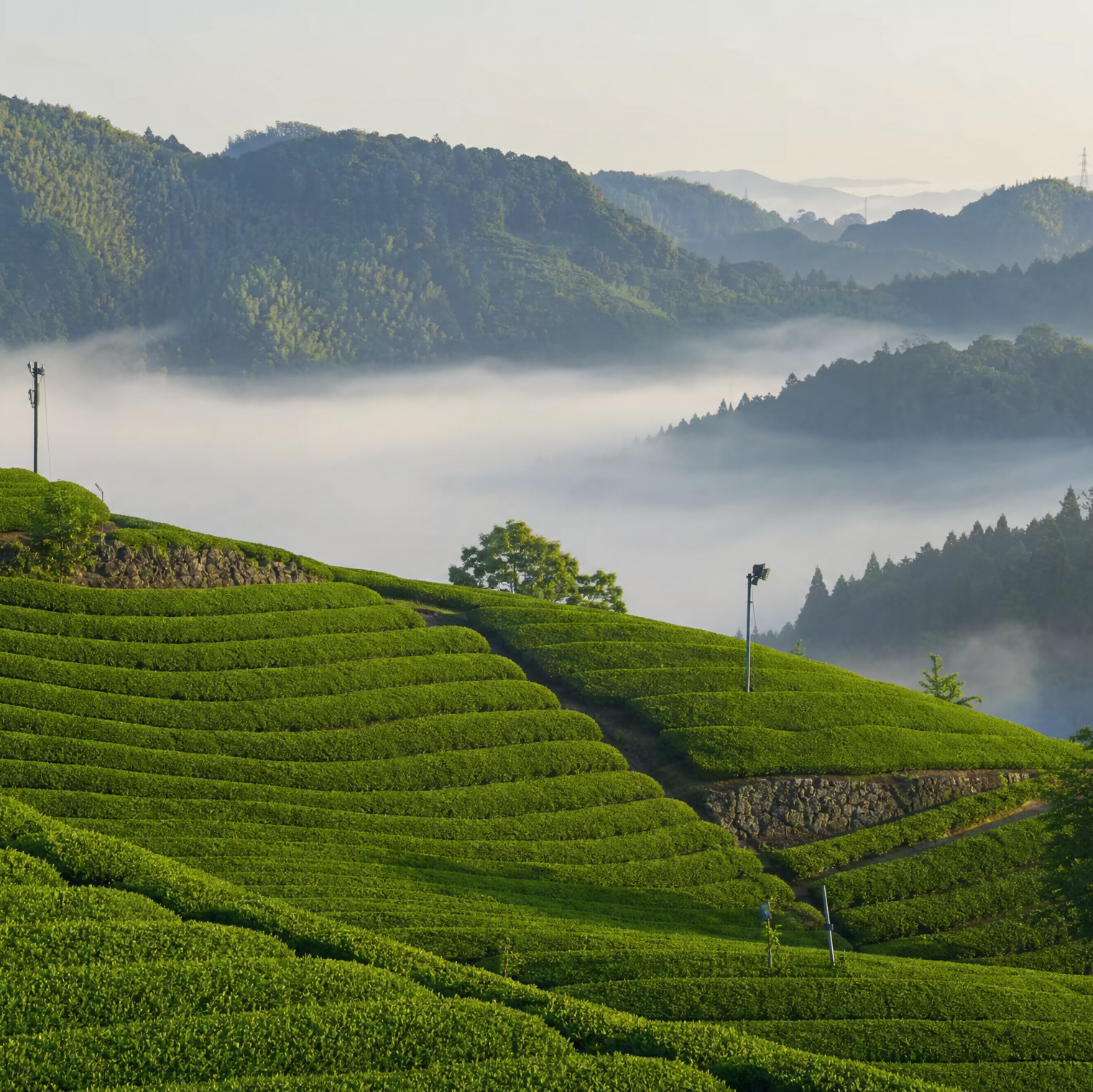
Uji, just south of Kyoto, is where Japanese tea culture began, and farmers there have been growing shade-covered tea on the same terraced fields for centuries. Tea takes on the character of the place where it grows, just like wine or coffee. The soil, the river mist and the cool nights all shape the flavour of the leaf. A blend smooths that character away, while a single-origin batch lets you taste it.
What is shade growing and why does it matter?
About thirty days before the harvest, the tea plants are covered so that most of the direct sunlight is blocked. This is the step that separates matcha from ordinary green tea. In the shade, the plant makes fewer of the bitter compounds and builds up more chlorophyll and amino acids instead. That is why good matcha tastes sweet and deep rather than sharp.
Most matcha sold outside Japan is grown with little or no shade, and often comes from a second or third harvest later in the year. It still says matcha on the label, but it tastes very different.
How is the matcha stone milled?
After picking, the leaves are steamed, dried and stripped of their stems and veins. What remains is called tencha, and grinding tencha into powder is where a lot of quality is won or lost. Most factories use fast steel mills, and that speed creates heat. Heat dulls the bright green colour and drives off the fresh aroma.
We grind on traditional granite mills instead. A stone mill turns slowly, stays cool and produces only a few grams of matcha per hour. It takes much longer, but the colour and the aroma survive the journey into the pouch.
Why does the colour matter: jade vs olive?
You can see the quality of matcha before you taste it. Shade-grown, stone-milled matcha has a vivid jade green colour. Matcha that was grown in full sun or damaged by heat looks olive, khaki or even yellowish. You do not need to be an expert to spot the difference when the two sit side by side.
The colour is a direct signal of how the tea was grown and ground, so a dull powder almost always means a dull and more bitter bowl.
What does this mean for your bowl?
When you put it all together, you get matcha that truly earns the word ceremonial: first harvest, at least thirty days of shade, one estate in Uji, ground slowly on stone. You can trace it, see it in the colour and taste it in the bowl.
Curious how it tastes? Try our 30g ceremonial matcha, stone-ground in small batches. And if you want to get the preparation right, the ritual walks you through it step by step.


You can see it before you taste it. Shade-grown, stone-milled matcha is jade, never olive.
First harvest
Thirty days of shade
One estate in Uji
Stone-ground
How you know it is real
Ceremonial grade is not a protected term, so the proof has to be visible. Three quick checks tell you almost everything about a matcha before you buy it.

01.
Look at the colour
Shade-grown, first-harvest matcha is vivid jade. A dull or olive powder almost always means a flat and bitter bowl.

02.
Check the origin
One estate, one harvest, one grind date. A blend smooths away the character of the place, a single origin lets you taste it.

03.
Read the label
Origin, harvest and milling belong on the pouch. Ours answers all three on the front, so you never have to guess.